
Treasures from the Vault
INEZ FOXX AT MEMPHIS
By 1973, Inez Foxx had already lived several musical lives.
A decade removed from “Mockingbird,” the million-selling 1963 hit she recorded with her brother Charlie Foxx, Inez arrived in Memphis in search of reinvention. She found it at Stax Records.
Born in Greensboro, North Carolina, Foxx first found her voice in church before taking her talents from the Gospel Tide Chorus to the secular stage. Alongside her brother Charlie, she became a transatlantic soul favorite through the 1960s, with charting follow-ups, regular tours in the U.K., and a devoted Northern Soul audience abroad. A later stint at Dynamo Records and songwriting work alongside then-husband Luther Dixon kept her in the industry’s orbit, but by the early 1970s, Foxx was searching for a fresh chapter.
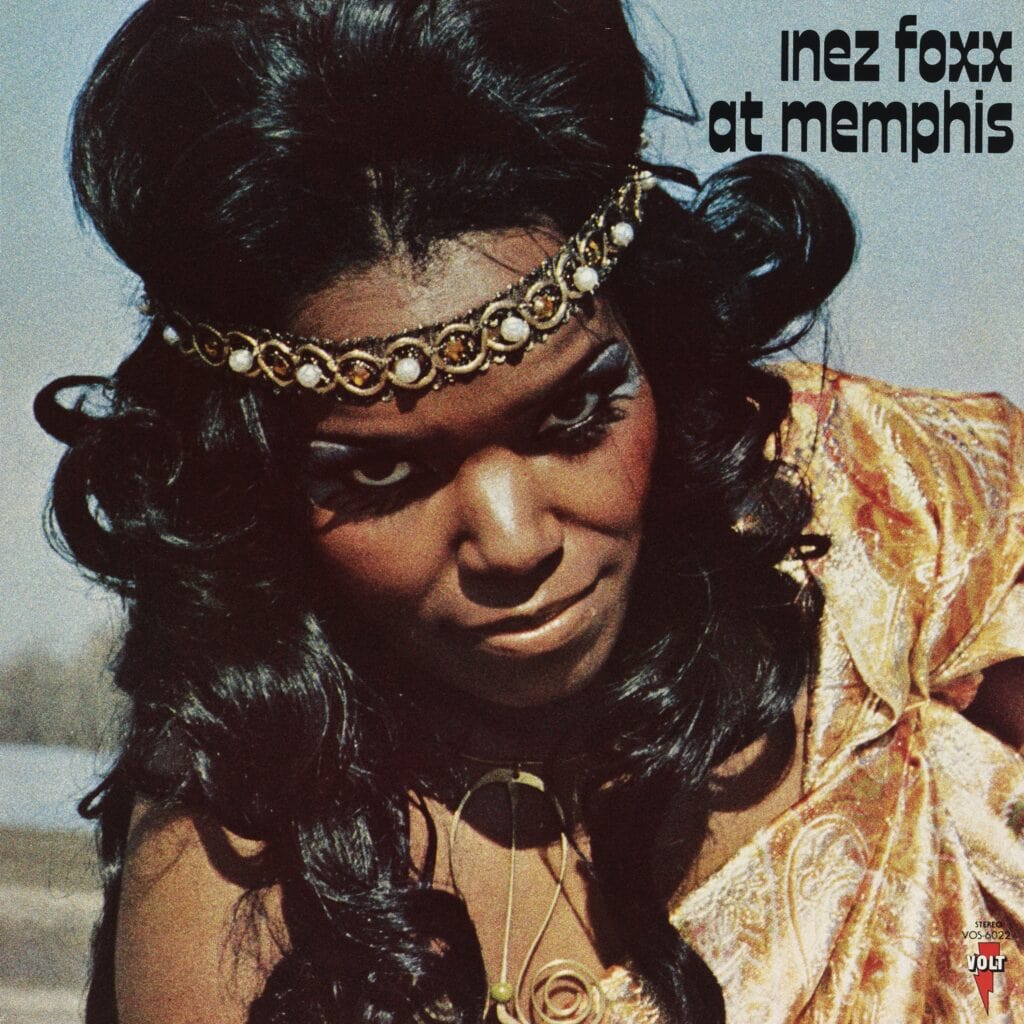 Released on Volt Records in 1973, At Memphis stands as the second and final proper solo album of Foxx’s career, a striking and often-overlooked set cut during one of the most turbulent and ambitious periods in Stax history. The label was riding the momentum of recent successes while expanding rapidly under its distribution deal with Columbia Records. New artists were arriving, payroll was swelling, and the pressure to produce hits was mounting. Foxx’s arrival in Memphis reflected both the promise and uncertainty of that era.
Produced by Randy Stewart, the former member of The Fiestas and longtime Stax utility man, At Memphis was built with an all-star cast. The sessions pulled from the deep bench of musicians and arrangers who helped define Memphis soul in the early 1970s. Willie Hall handled drums, while bassist William Murphy anchored the rhythm section. On guitar, Foxx was backed by a formidable trio that included Skip Pitts, whose wah-wah work helped define “Theme from Shaft,” alongside Bobby Manuel and Michael Toles. Keyboardists Lester Snell and Marvell Thomas added depth, while Memphis native James Mitchell, brother of Hi Records architect Willie Mitchell and a frequent collaborator with the Memphis Horns, shaped the horn arrangements and contributed baritone sax.
Members of the Memphis Horns, including Wayne Jackson and Andrew Love, brought punch and polish throughout. But At Memphis also reached beyond the city’s usual circle. Cleveland-born arranger Wade Marcus, a jazz-trained trombonist who had played in Lionel Hampton’s orchestra and cut his arranging teeth at Motown, contributed sweeping string and horn arrangements that gave the album a cinematic sheen. His presence nudged Foxx’s Memphis recordings toward the lush, orchestrated sound that had become commercially viable in the post-Shaft era. Even the backing vocals reflected Stax’s ambition and depth. Hot, Buttered & Soul, the female vocal group assembled by Isaac Hayes in 1969 as part of his touring and recording orbit, added layered harmonies that tied Foxx’s sessions to the broader, more expansive sound the label was cultivating in the early 1970s. Fellow backing vocalist Deborah Manning brought even more Stax pedigree to the sessions. A gifted Memphis singer whose voice first appeared on the children’s chorus of “Soul Finger” by The Bar-Kays, Manning had already performed solo before more than 100,000 fans at Wattstax in 1972.
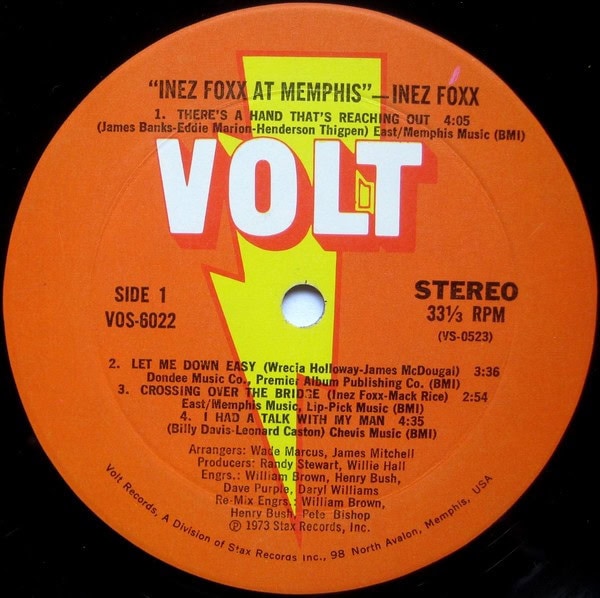 If Foxx’s earlier hits thrived on immediacy and vocal interplay, At Memphis often swings for grandeur. The initial focus, 7” single “You Hurt Me for the Last Time” (later available on companion 1990 CD release At Memphis and More), is steeped in Southern soul heartbreak, pairing Foxx’s seasoned vocal grit with Stax’s signature rhythm section swagger. On the flip side, “Watch the Dog (That Brings the Bone)” leans funky and playful, hinting at the label’s effort to chase contemporary trends. Elsewhere, Foxx takes on Baby Washington’s “The Time,” delivering one of the album’s strongest performances. On “You’re Saving Me for a Rainy Day,” an airy, dainty introduction gives way to one of the album’s most tender moments, as Foxx balances mature command with an almost innocent sincerity. Her vocal is controlled and graceful, revealing a softer side of her artistry amid the album’s larger, more dramatic arrangements. Meanwhile, “Crossing Over the Bridge” leans into her gospel roots, allowing Foxx to channel the church-bred power and conviction that first shaped her voice. The song’s uplifting vocal phrasing and spiritual undertones feel both reverent and symbolic in hindsight, a bridge between eras, labels, and identities. “I Had a Talk with My Man,” the album’s only charting single, cracked the R&B charts in late 1973, while 1974’s “Circuits Overloaded” (also eventually annexed on At Memphis and More) returned Foxx to the chart once more.
The album closes on an especially local note, with “Mousa Muse.” Set against music, veteran Memphis broadcaster Perry Allen Jr. conducts a brief on-record conversation with Foxx, who speaks candidly about her inspirations and her excitement around joining the Stax and Memphis music family. Allen, a longtime Memphis radio personality, educator, and one of the Mid-South’s foremost jazz authorities, lends to the moment the feel of an on-air welcome, as though Memphis itself is introducing Foxx as its newest soul citizen.
Stax seemed determined to find Foxx’s next hit from every possible angle. At Memphis shifts between deep soul, funk, crossover, gospel testimony, and contemporary storytelling, making the album feel less like a singular artistic statement than a label searching for the right lane for a proven hitmaker.
But as Foxx searched for her next chapter, her past was already returning to the spotlight.
In 1974, while James Taylor and Carly Simon returned “Mockingbird” to the Top Five, Foxx passed on “Woman to Woman,” a song that would become a million-selling smash for Shirley Brown. It was one of the great “what ifs” of Foxx’s Stax years.
Though Foxx quietly exited the recording industry after Stax’s collapse, At Memphis did not disappear. One of its most enduring tracks, “Let Me Down Easy,” opens with a sorrowful, cinematic introduction, led by swirling woodwinds and a distinct oboe passage before a swell of brass clears the way for Foxx’s mournful ode to unrequited love. In some ways, the arrangement plays like a condensed, female-fronted cousin to “Walk on By” as interpreted by Isaac Hayes: dramatic, orchestral, and emotionally expansive. In the decades since, that lush opening and aching vocal have made the song a favorite among hip-hop producers, appearing in dozens of songs by artists and producers including 9th Wonder, DJ Premier, Ghostface Killah, and Harry Fraud. Other tracks from the album, including “Mousa Muse” and “I Had a Talk with My Man,” have also been repurposed by later generations, proving that even if At Memphis was overlooked in its own time, its grooves continued to travel.
In retrospect, At Memphis remains more than just a late-career detour. It is the sound of a veteran artist meeting Memphis soul at a crossroads, one final reinvention attempt cut in the middle of a label’s last great push.
By Jared Boyd
Treasures from the Vault Archive
Sep. 03, 2026
Yesterday Is Gone

Aug. 06, 2026
Jammed Together

Jun. 23, 2026
Lou Bond

Jun. 05, 2026
Talking to the People
May. 01, 2026
INEZ FOXX AT MEMPHIS

Apr. 02, 2026
The Master

Mar. 04, 2026
Funky Sounds Buried in the Fertile Soil of Memphis That Smells of Rock
Feb. 03, 2026
The Many Grooves of Barbara Lewis

Jan. 08, 2026