
Oct. 01, 2026
Treasures from the Vault
With A Little Help From My Friends
The title of Steve Cropper’s first solo album was particularly apt. By the time With a Little Help From My Friends arrived on Volt Records in 1969, Cropper had spent most of a decade making music with plenty of help from his friends.
As guitarist for Booker T. & the M.G.’s, Cropper was one-fourth of the instrumental unit at the center of the Stax sound. Outside the group, he served as a songwriter, producer, engineer, A&R man, and de facto studio manager, helping shape records for Otis Redding, Wilson Pickett, Eddie Floyd, Albert King, and many others. Collaboration was not merely part of Cropper’s working method. It was the working method that helped establish Stax Records.
Yet With a Little Help From My Friends offered something different. With Cropper credited as producer and arranger, the instrumental album removed the singers who so often occupied the foreground of his work and left his musical instincts more exposed. Even the identities of the musicians accompanying him went undocumented on the original release. What remained was an unusually direct expression from a musician whose greatest talent often involved figuring out exactly what somebody else’s record needed.
 Cropper had been learning that skill since his teenage years in Memphis. After moving to the city from Missouri as a child, he joined a circle of young musicians who formed the Royal Spades, later renamed the Mar-Keys. Their 1961 instrumental “Last Night” became an early hit for the fledgling Satellite label, soon renamed Stax Records. Cropper eventually abandoned touring for the studio, where the loose collection of musicians working behind Stax artists solidified into Booker T. & the M.G.’s. Their 1962 debut single, “Green Onions,” became an even bigger instrumental hit, launching a successful recording career that ran parallel to the group’s work as the house band behind many of Stax’s defining records.
Cropper’s understated guitar became one of Stax’s signatures, but his role at the label stretched well beyond playing. By the middle of the decade, he had become integral to nearly every stage of making records, co-writing “In the Midnight Hour” with Wilson Pickett and “Knock on Wood” with Eddie Floyd, while developing an especially productive songwriting partnership with Otis Redding. The depth of that responsibility became especially clear after Redding’s death in December 1967. Having co-written and recorded “(Sittin’ On) The Dock of the Bay” with Redding only days earlier, Cropper was entrusted with completing the final mix of the song that would become Redding’s first No. 1 pop hit. Cropper’s value was not simply in what he contributed to a session, but in his understanding of how all its pieces should come together.
After Stax’s separation from Atlantic Records, the Memphis company lost control of the master recordings that made up much of its existing catalog. Stax responded by rapidly rebuilding, culminating in the ambitious 1969 Soul Explosion campaign and the release of 28 albums. Among them was With a Little Help From My Friends, alongside new records from established Stax names and debut albums from a growing roster of artists.
For Cropper, the occasion offered a chance to revisit the music that shaped his career from the other side of the microphone.
Cropper returns to two songs he helped write with Wilson Pickett, “99 1/2” and “In the Midnight Hour,” but approaches the familiar material on his own terms. The especially funky arrangement of “99 1/2” leans heavily into the groove, allowing his rhythmic guitar work to drive the song in the absence of Pickett’s vocals. Elsewhere, Cropper rearranges the ensemble around his guitar. On “Oh, Pretty Woman,” his guitar trades phrases with the organ in a call-and-response that recalls Booker T. & the M.G.’s, only with Cropper commanding more of the melodic foreground. The blaring horns of “I’d Rather Drink Muddy Water” provide a different kind of counterpoint, adding force around his guitar without overwhelming it.
Those choices make the album as much a showcase for Cropper the arranger as Cropper the guitarist. Rather than pursuing virtuosity for its own sake, he constructs different surroundings in which his economical playing can occupy the foreground.
Cropper was not simply revisiting old assignments, either. Five of the album’s 11 selections bear his name as a writer or co-writer. The solemn, bluesy mood of “The Way I Feel Tonight” reveals a more contemplative side of the record, while “Rattlesnake” takes an almost literal approach to its title, making room for an auxiliary percussion passage whose persistent shake evokes the reptile’s rattle. “Crop-Dustin’,” co-written with Buddy Miles, opens the album with another Cropper original. Three decades later, “Crop-Dustin’” resurfaced when hip-hop producer DJ Premier sampled the track for Jay-Z’s street anthem “So Ghetto” in 1999.
Then there is the title track. The Beatles had released “With a Little Help From My Friends” only two years earlier on Sgt. Pepper’s Lonely Hearts Club Band. Cropper stretches the Lennon-McCartney composition beyond five minutes and recasts it as an instrumental, placing one of the era’s most recognizable British rock songs into the musical language he had developed in Memphis.
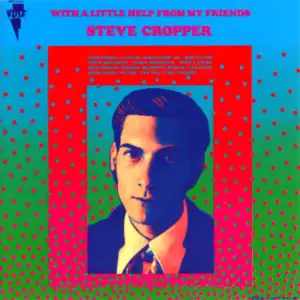
The album’s presentation pushed the connection to contemporary rock culture even further. Its brightly colored cover was illustrated by Victor Moscoso, whose work was closely associated with San Francisco’s psychedelic poster art. Cropper appears without a guitar on the front, surrounded instead by vivid color, stars, and geometric patterns. For an artist so closely associated with the economical sound of a Fender Telecaster, the package makes surprisingly little effort to sell him as a conventional guitar hero.
The original credits reveal just how thoroughly the album belonged to Cropper. He is listed not only as the featured artist, but also as producer and arranger, and as one of four engineers alongside Ron Capone, Bobby Manuel, and Gordon Rudd. Rather than simply spotlighting Stax’s guitarist, With a Little Help From My Friends placed several responsibilities Cropper had already assumed behind the scenes under his own name.
Stax apparently had ambitions for the album beyond simply filling out its rapidly expanding catalog. Reviewing With a Little Help From My Friends in its July 12, 1969, issue, Record World declared, “Stax/Volt is out to make a star of Steve Cropper,” pointing to the exposure and promotion the label had placed behind him.
That effort reflected the unusual possibilities created by Stax’s scramble to rebuild. The same Soul Explosion campaign elevated longtime staff songwriter and producer Isaac Hayes, whose Hot Buttered Soul achieved the kind of commercial breakthrough that eluded Cropper’s album. In both cases, Stax looked within its own studio ranks for personnel who might also command albums under their own names.
With a Little Help From My Friends did not transform Cropper into a solo star. More than half a century later, that relative obscurity is part of what makes the album so revealing. Cropper did not need a solo record to establish his sound; by 1969, that sound was already embedded throughout the Stax catalog. His debut instead offered the rare chance to hear one of the label’s principal architects rearrange pieces of the musical world he had helped construct.
Perhaps the greatest help Cropper’s friends could offer was to step back and let him come forward. For once, the record was his.
By Jared Boyd
SHOP THE STAX STORE
Treasures from the Vault Archive
Sep. 03, 2026
Yesterday Is Gone
Aug. 06, 2026
Jammed Together
Jun. 23, 2026
Lou Bond

Jun. 05, 2026
Talking to the People

May. 01, 2026
INEZ FOXX AT MEMPHIS
Apr. 02, 2026
The Master
Mar. 04, 2026
Funky Sounds Buried in the Fertile Soil of Memphis That Smells of Rock
Feb. 03, 2026
The Many Grooves of Barbara Lewis
Jan. 08, 2026