
Treasures from the Vault
Obie from Senatobie
In a South where the sounds of country music radio were hardly foreign to Black audiences, rural Mississippi native O.B. McClinton spent his childhood dreaming of becoming a country star. When Stax Records signed the singer-songwriter in the early 1970s, its ambition to bring a Black country artist to a predominantly white market was earnest. But in its effort to establish his country credentials, the company placed McClinton in a Nashville recording environment that left him feeling like a stranger to his own music.
The experience might have discouraged a less determined performer. Instead, McClinton persuaded Stax executive Al Bell to give him greater control over his next album. The resulting Obie from Senatobie, released on the company’s Enterprise imprint in 1973, offered a more personal expression of McClinton’s musical identity. Drawing on the familiar sounds of Nashville while embracing the songwriting traditions of Memphis soul, the album presented country audiences with fresh perspectives on songs they might have encountered in entirely different settings.
For McClinton, however, the road to Nashville had begun long before Stax came calling.
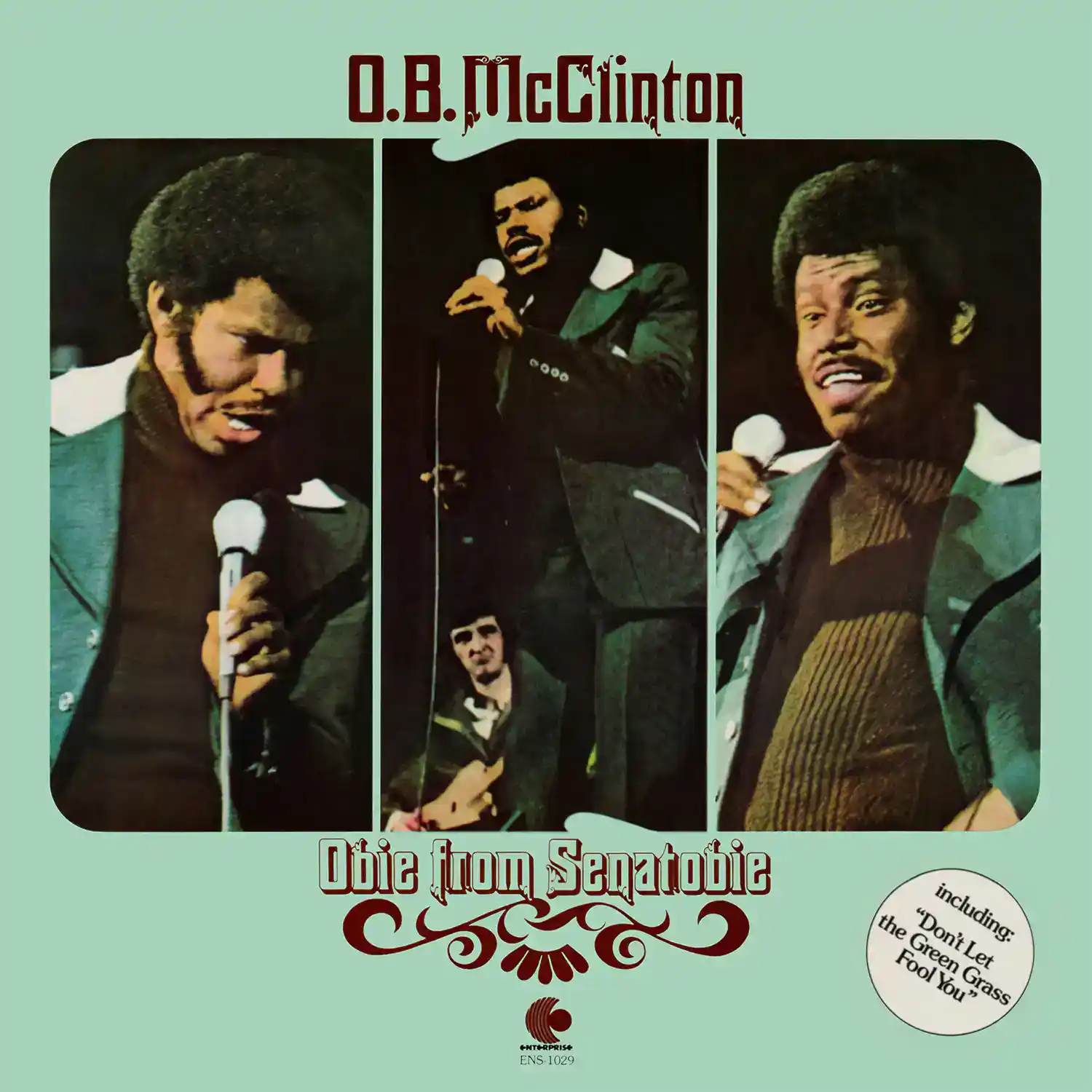 Born in 1940 and raised in the Gravel Springs community near Senatobia, Mississippi, McClinton grew up in a large family headed by a minister and farmer. Although the family owned hundreds of acres of farmland, the young McClinton had little enthusiasm for making his living in the fields. Instead, he fixated his imagination on the country music he heard on the radio, particularly recordings by Hank Williams.
His parents grew so concerned by the unlikely career he envisioned that they arranged for a doctor to evaluate him. However, his ambitions were so consuming that he reportedly ran away to Memphis at age 14, determined to chase country stardom.
Memphis nevertheless became an important proving ground. While attending Hamilton High School, McClinton won a talent contest singing Elvis Presley’s “Blue Suede Shoes.” He also performed with WDIA’s Teen Town Singers. He won a station talent competition with Tennessee Ernie Ford’s “Sixteen Tons,” before attending Rust College in Holly Springs on a choral scholarship.
His musical education extended well beyond country. McClinton absorbed the sounds of Memphis’s flourishing rhythm-and-blues scene and worked as a disc jockey at WDIA. It was through radio that he first encountered Al Bell, then working at rival station WLOK, establishing a connection that would prove important years later.
McClinton also served in the U.S. Air Force, spending time overseas in Okinawa. There, a fellow serviceman introduced him to the music of Charley Pride. Discovering that Pride was a Black Mississippian succeeding in country music helped McClinton realize the career he had imagined since childhood might finally be within reach.
Meanwhile, McClinton’s songwriting was finding a home in soul music. McClinton placed “Keep Your Arms Around Me” with Stax giant Otis Redding. For nearby Goldwax Records, he contributed to “You’ve Got My Mind Messed Up” and “A Man Needs a Woman,” recorded by cult hero James Carr. His ability to craft songs of heartbreak, longing, and romantic uncertainty translated naturally between the musical traditions he loved.
By 1971, a bidding war for McClinton’s services as a performing artist began between Nashville’s Chart Records and Stax. He ultimately chose the Memphis label after it offered a reported $10,000 advance. Still, Stax enlisted Nashville producer Jim Malloy to oversee his country debut, hoping to establish his credibility with the country establishment. As music historian, author, and Professor Charles L. Hughes observes in “I’m the Other One: O. B. McClinton and the Racial Politics of Country Music in the 1970s,” McClinton’s pursuit of country stardom through Stax represented “two seemingly irreconcilable cultural positions.” Those tensions followed him into the studio. In interviews with Stax historian Rob Bowman, McClinton recalled that Malloy repeatedly pushed him toward a higher, more nasal delivery that would make him sound less recognizably Black. The resulting album, O.B. McClinton Country, failed to capture the singer’s own sense of himself.
McClinton wanted another chance, but this time on his terms. With Bell’s support, he returned to Nashville’s Monument Studios with many of the same musicians, assuming greater responsibility for the arrangements and co-producing the sessions with engineer Tommy Strong.
Obie from Senatobie establishes its musical premise in the opening notes of its first track, “I Want You in the Morning.” A tight, soulful bassline immediately gives way to a high-pitched, swaying harmonica before McClinton enters with a decidedly forlorn vocal. Steel guitar, acoustic strumming, gentle backing harmonies, and lightly punctuated percussion fill out the arrangement, blending familiar Nashville country textures with the rhythmic warmth of Southern soul.
Trying his hand at a familiar soul cover on album standout, “Don’t Let the Green Grass Fool You,” McClinton finds an unlikely sense of jubilation in a cautionary tale of romantic temptation. Where Wilson Pickett’s familiar soul recording leaned on punchy horns, McClinton punctuates the song with weeping steel guitar. His performance prioritizes emotional directness, humor, and irony over twang. The interpretation connected with country listeners and reached No.37 on Billboard’s Hot Country Singles chart.
“She’s That Kind” offers another showcase for the deep, rich texture of McClinton’s voice. His unhurried delivery lends the storytelling an easy sincerity, as though he’s confiding in the listener rather than performing for an audience. That intimacy gives way to the driving, danceable rhythm of “My Whole World Is Falling Down,” where McClinton turns romantic misfortune into a sly joke at his own expense. Having mistreated a former lover, the narrator now finds himself beset by one calamity after another. The recording became his highest-charting country single, reaching No.36.
Traveling thematically to the Motown songbook, McClinton visits the Temptations’ “I Wish It Would Rain.” In his rendition, McClinton exchanges the anguished intensity of David Ruffin’s original performance for a more conversational sorrow. Guitar picking, fiddle, and distinctive backing harmonies frame a vocal punctuated by half-spoken interjections of “Oh, Lord” and “Aw, nawl.” Those little departures from the written lyric lend the performance its character, as though McClinton is confiding his troubles directly to the listener.
He also revisits the Stax-associated classic “(If Loving You Is Wrong) I Don’t Want to Be Right,” transforming Luther Ingram’s deeply contemplative soul standard into a midtempo country performance with an almost danceable pulse. Here, McClinton offers some of his most dexterous vocal flourishes, his voice trembling and turning nearly croaky as he negotiates the song’s forbidden romance. At moments, he sounds as though the confession itself is too painful, or too scandalous, to deliver plainly.
The title track, “Obie from Senatobie,” offers a playful answer to Merle Haggard’s “Okie from Muskogee,” which McClinton had covered on his previous album. Drawing on a story from his military years, McClinton turns his hometown into a source of pride in the face of ridicule. Its humor occasionally draws on uncomfortable racial stereotypes, but the song also offers a revealing portrait of a performer accustomed to having his identity treated as an oddity.
Despite yielding two Top 40 country singles, Obie from Senatobie failed to reach the album charts. Its significance, however, extends beyond its commercial failure. McClinton had secured something that would prove elusive throughout the remainder of his recording career: the freedom to determine how his music should sound.
Looking back on his years at Stax, he credited Al Bell with granting him that opportunity, recalling that he never again enjoyed the same degree of creative control. Heard today, Obie from Senatobie offers more than an inventive meeting of country and soul. It captures a gifted singer and songwriter, long accustomed to navigating other people’s expectations, finally making a record on his own terms.
By Jared Boyd
Treasures from the Vault Archive
Nov. 12, 2026
Obie from Senatobie
Oct. 01, 2026
With A Little Help From My Friends
Sep. 03, 2026
Yesterday Is Gone
Aug. 06, 2026
Jammed Together

Jun. 23, 2026
Lou Bond
Jun. 05, 2026
Talking to the People
May. 01, 2026
INEZ FOXX AT MEMPHIS
Apr. 02, 2026
The Master

Mar. 04, 2026
Funky Sounds Buried in the Fertile Soil of Memphis That Smells of Rock
Feb. 03, 2026
The Many Grooves of Barbara Lewis
Jan. 08, 2026